

Choosing the correct headsail furling system involves more than matching a furler to the length of the yacht. The forestay diameter, stay material, forestay length, lower attachment, clevis-pin size, available bow clearance and sail arrangement all affect which system and configuration will fit correctly.
Forestay diameter
The furler must be suitable for the forestay wire or rod diameter.
Stay length
Maximum and minimum stay lengths affect foil quantity and system sizing.
Terminal arrangement
Lower and upper fittings must work with the selected furler and yacht structure.
Yacht use
Cruising load, sail area and operating requirements help determine the appropriate system size.
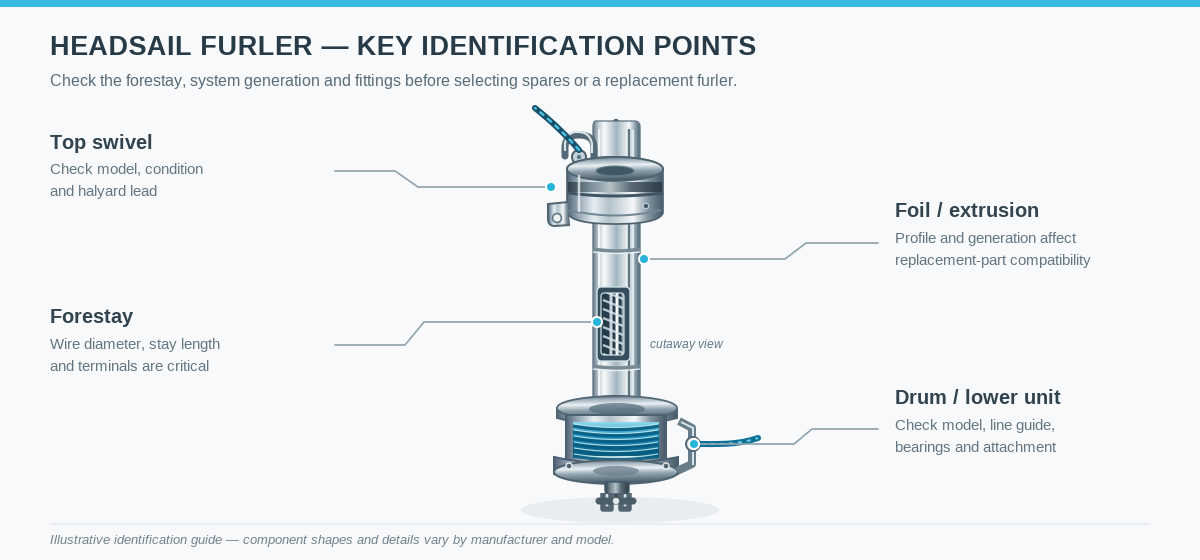
This guide explains the information we use when specifying a new headsail furler and gives a starting point for comparing Seldén Furlex 104S–404S with Harken MKIV Ocean.
Choose the Right Furling System for Your Yacht
Compare the main systems or send us your yacht and forestay details for help choosing the correct configuration.
What Determines the Correct Furler Size?
Boat length is useful as an initial guide, but it should not be used on its own. Two yachts of similar length can have very different rig loads and forestay arrangements.
Before ordering a new furler we normally establish the following:
- yacht make, model and year;
- forestay diameter;
- whether the stay is 1x19 wire, compact strand or rod;
- overall forestay length;
- lower terminal and chainplate arrangement;
- clevis-pin diameter;
- available space around the bow fitting and anchor;
- existing or proposed sail luff arrangement; and
- whether the system is to be manual, electric, hydraulic or through-deck.
1. Check the Forestay Diameter and Material
The forestay is one of the first measurements to confirm. Furlers are manufactured for specific stay diameters, and the same furler model may be available in several different configurations.
Do not assume the forestay diameter from the yacht's length or from another yacht of the same model. Rigging may have been changed during the life of the yacht, and performance versions can differ from standard boats.
If the yacht uses rod or compact-strand rigging, this should be identified before selecting the system because the required terminals, bushes or adaptors can differ from a standard 1x19 wire installation.
2. Measure the Forestay Length
The complete forestay length determines the foil requirement and whether the standard kit provides sufficient extrusion length. A system that suits the wire diameter is not automatically suitable for every stay length.
When replacing an existing furler and forestay together, measurements should be taken from the relevant bearing points rather than simply measuring the visible wire.
3. Check the Lower Attachment and Clevis Pin
The connection between the furler and the yacht is just as important as the stay diameter. Record the chainplate or stem fitting, clevis-pin diameter, toggle arrangement and available articulation.
The correct toggle allows the forestay connection to articulate as intended. A furler should not be made to fit by drilling out a chainplate or fitting an inappropriate clevis pin.
4. Check Drum Clearance at the Bow
The furling drum must clear the stem fitting, pulpit, anchor and other deck hardware while allowing the furling line to lead away cleanly.
On some yachts the drum needs to be raised using the correct link or toggle arrangement. This can affect the available sail luff length, so drum position should be considered before the sail or forestay dimensions are finalised.
5. Check the Sail and Luff Arrangement
The foil profile and available luff length need to suit the headsail. If an existing sail is being retained, its luff length, luff tape and tack/head arrangement should be checked against the proposed system.
Correct halyard geometry is also important. Poor halyard lead can contribute to halyard wrap and difficult furling, so the complete installation should be considered rather than the drum alone.
Seldén Furlex 104S–404S: Starting Guide
The current Seldén Furlex range covers several yacht and forestay sizes. The table below is a useful starting point, but final selection should also take account of rig load, forestay length and installation geometry.
| Furlex | Typical Yacht Length | 1x19 Forestay Diameter |
|---|---|---|
| 104S | 22–30 ft | 4, 5 or 6 mm |
| 204S | 28–40 ft | 6, 7 or 8 mm |
| 304S | 35–45 ft | 8 or 10 mm |
| 404S | 40–60 ft | 12 or 14 mm |
See our Seldén Furlex 104S, 204S, 304S and 404S range for the available systems and configurations.
Harken MKIV Ocean: Starting Guide
Harken MKIV Ocean units are selected using the headstay size together with the required lower toggle and clevis-pin arrangement. Rod-compatible configurations are also available.
| Harken Unit | 1x19 Wire Sizes | Rod Sizes | Chainplate Clevis Pins |
|---|---|---|---|
| Unit 0 | 4, 5, 6 mm | -4, -6 | 7.9, 9.5, 11.1 mm |
| Unit 1 | 6, 7, 8 mm | -8, -10, -12 | 12.7, 15.9 mm |
| Unit 2 | 8, 10, 12 mm | -12, -17, -22 | 15.9, 19.1 mm |
| Unit 3 | 11, 12, 14, 16 mm | -22, -30, -40, -48 | 19.1, 22.2, 25.4, 28.6 mm |
See the Harken MKIV Ocean range for the individual systems.
Seldén Furlex or Harken MKIV Ocean?
Both ranges provide several sizes for cruising yachts, but their product families and installation options differ.
Seldén's Furlex range extends beyond conventional manual deck-mounted furlers to include through-deck, electric and hydraulic systems. This can be useful when the installation brief includes powered operation or a particular deck layout.
Harken MKIV Ocean is a manual jib reefing and furling range with unit sizes matched to defined wire, rod and lower-toggle dimensions. The correct unit therefore needs to be checked against the actual forestay and chainplate arrangement.
Rather than selecting by brand first, we recommend establishing the yacht's rigging and installation requirements and then comparing the systems that satisfy those requirements.
Manual, Electric or Through-Deck Furling?
A conventional manual furler is suitable for many cruising yachts, but it is not the only option.
An electric system can reduce the physical effort required to furl a large headsail, while a through-deck installation can move more of the furling equipment below deck and reduce the amount of equipment visible above the bow fitting. Larger yachts may also use hydraulic furling systems.
The choice should consider the yacht's electrical or hydraulic systems, available installation space, access for servicing and how the boat is normally sailed.
Replacing the Furler Is a Good Time to Check the Forestay
If an older furler is being replaced, the condition and age of the forestay should be considered at the same time. Installing a new furling system around an ageing forestay can mean dismantling the new system again when the standing rigging is replaced.
Where appropriate, replacing the furler and forestay together allows the complete assembly to be measured and specified as one system.
Information to Send Us for Furler Selection
For the most useful recommendation, send us:
- yacht make, model and year;
- forestay diameter and material;
- forestay length if known;
- clevis-pin diameter;
- photographs of the lower forestay attachment;
- photographs of the existing furler, if fitted;
- details of any electric or hydraulic system already aboard; and
- whether the existing headsail will be retained.
If you are replacing only the control line, see our furler control line replacement guide. For older Furlex equipment and component identification, see our Seldén Furlex spare-parts lists and manuals.
Need Help Choosing a Furler?
Martin Leaning Masts & Rigging can help identify the correct system from your yacht and rigging details. Browse our complete yacht furling systems or request a rigging estimate and send us the dimensions and photographs of your existing installation.