

Correctly identifying an existing mast is the starting point for replacement parts, repairs and complete mast replacement. A yacht model or manufacturer name helps narrow the search, but the mast itself should be checked before parts are specified.
Three things to record first
A useful mast-identification enquiry normally starts with the ID, the extrusion dimensions and clear photographs of the fittings.
Find the mast ID
Check the lower end of the aluminium mast for an engraved manufacturer or mast ID. Photograph the complete marking rather than copying only the largest number.
Measure the section
Record the fore-and-aft dimension and the athwartships width of the aluminium extrusion itself, excluding external track inserts and fittings.
Photograph the fittings
Include the mast heel, masthead, spreader roots, gooseneck, stay attachments, sail track and halyard exits.
Record the yacht
Send the yacht make, model and build year, plus the mast manufacturer if known. Production yachts can still carry different rigs.
Mast identification and measurement examples
These two reference panels show the two most useful pieces of evidence when identifying an unknown aluminium mast.
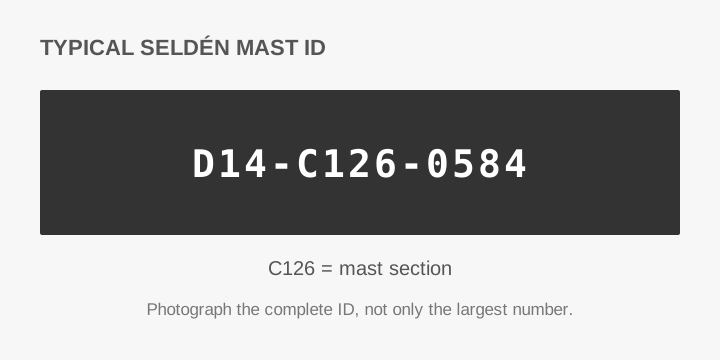
Mast ID example
Photograph the complete engraved ID at the lower end of the mast. In the example shown, C126 identifies the mast section.
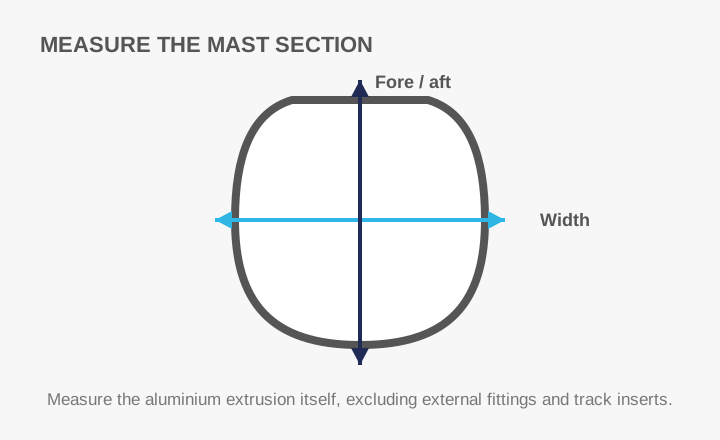
Section measurements
Record both fore-and-aft section length and athwartships width, and measure the extrusion rather than external fittings.
Look for the mast ID at the lower end of the spar
Seldén states that since 1992 it has engraved a unique mast ID into its aluminium mast sections. The ID is found at the lower end of the mast and includes the mast-section designation.
Measure the mast section
If the mast ID is missing or unreadable, measure the aluminium extrusion itself. Seldén's sailmaker information uses section length and section width together with the section shape when identifying a mast.
Fore / aft
Measure the section length in the fore-and-aft direction. Keep the tape or caliper square to the extrusion.
Athwartships
Measure the maximum section width across the mast. Do not include external fittings or local reinforcement.
Section shape
Take a square-on photograph of the extrusion profile. Similar overall dimensions can hide different aft faces, grooves and internal geometry.
Photographs that help us identify the mast
- Mast heel: engraved ID, heel plug, step interface and lower extrusion.
- Masthead: headbox, sheaves and forestay/backstay attachments.
- Spreader roots: bracket style, number of spreaders and local fittings.
- Gooseneck: boom fitting and mast-side bracket arrangement.
- Stay terminals: T-terminals, eyes, stemballs or other mast attachments.
- Sail track and exits: luff groove, sail sliders, halyard exits and feeders.
Older Seldén and Kemp mast families
Seldén's current sailmaker guide groups conventional masts from roughly 1977–2002 mainly as D and E sections, with R sections used for furling masts. From 2003, conventional ranges moved to C sections and furling ranges to F sections, with later generations introduced subsequently.
This history helps narrow the search, but it is not a substitute for checking the individual mast. A current component should not be assumed to fit an older section simply because the overall dimensions look similar.
Z-Spar, Sparcraft and other manufacturers
Where a clear manufacturer ID is not available, dimensions and photographs become even more important. Record the mast section, mast length where practical, spreader arrangement, mast heel, gooseneck and stay-attachment details.
If the original section is obsolete, exact identification is still useful because the project may move from finding an original component to specifying a supported replacement mast.
Need help identifying your mast?
Send us the yacht details, mast ID if visible, section dimensions and the photographs above. If you need a replacement fitting, include close-ups with a ruler or tape measure in the image.