

Seldén's aluminium dinghy mast range uses named sections with different dimensions, weights and stiffness characteristics. The correct section depends on the class and, in some classes, the crew weight and sail/tuning setup.
Current Seldén aluminium dinghy mast section range
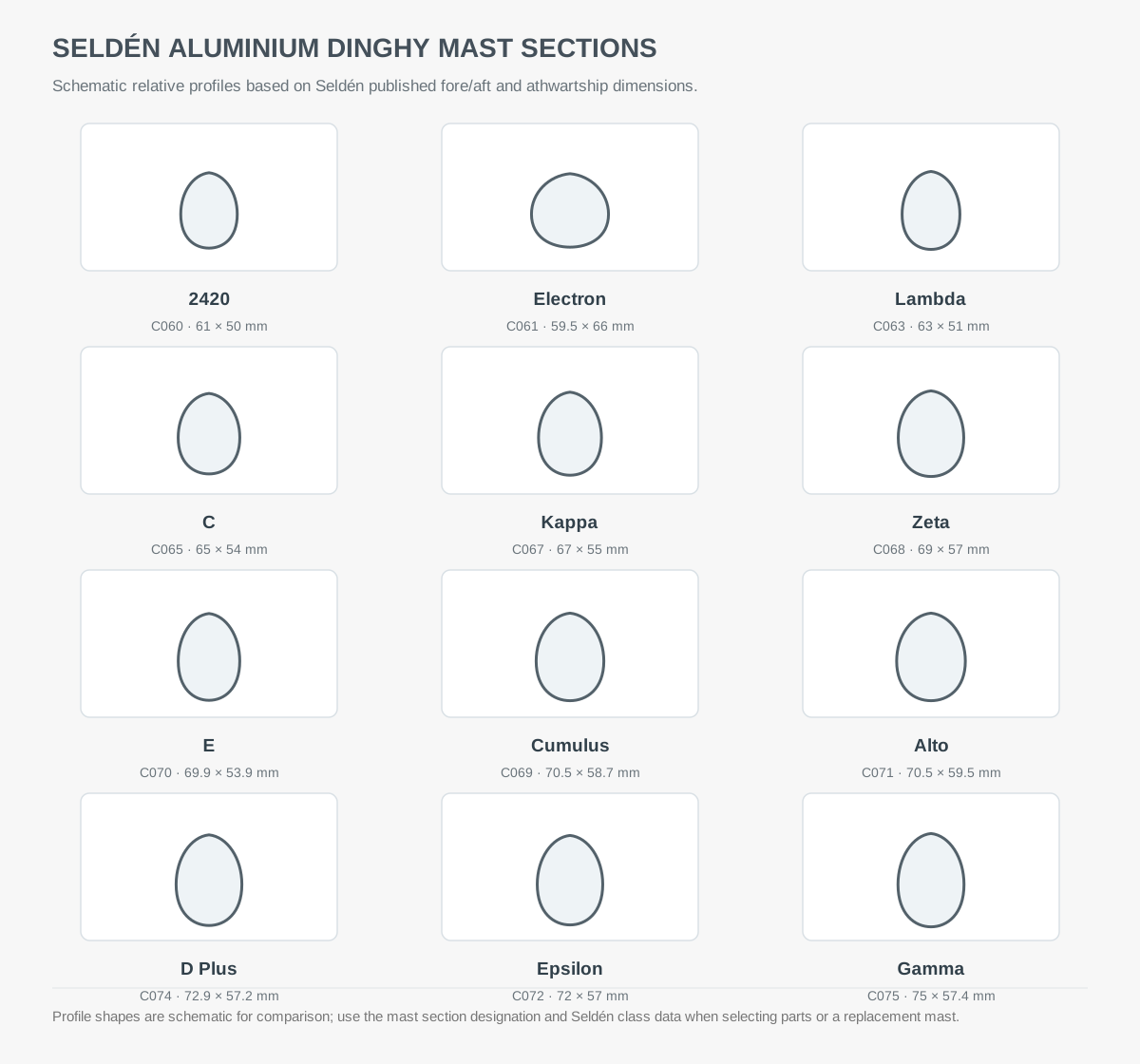
The relative profiles above are based on Seldén's published section dimensions. They are a comparison aid rather than a manufacturing drawing; use the section designation and class-specific data when selecting a mast or fitting.
What changes between sections?
Fore / aft stiffness
This affects how the mast bends under rig and sail loads and influences mainsail shape and gust response.
Sideways stiffness
Lateral stiffness matters to rig stability and how the mast responds to shroud and spreader settings.
Section weight
A section's mass per metre affects the overall spar weight as well as its handling characteristics.
Section shape
Dimensions and wall distribution influence stiffness; the same nominal size does not guarantee the same behaviour.
Examples from the Seldén range
Seldén's current aluminium mast information includes sections such as 2420, Lambda, C, Kappa, Zeta, Cumulus, Alto, D Plus, Epsilon and Gamma. Different sections are associated with different classes and stiffness ranges.
For example, Seldén lists Cumulus as suitable across a broad group of classes including 420, 470, 505, Albacore, Fireball, Scorpion, Solo, RS200, RS400 and GP14, while other sections are aimed at different class and stiffness requirements.
Why class data matters
A section that appears suitable by dimensions alone may not be permitted or appropriate for a particular class. Use the class-specific mast data, class rules and the current Seldén specification when selecting a replacement.
Identifying your existing dinghy mast
Unsure which Seldén dinghy section you need?
Send the class, current section and photographs of the mast and fittings. We can help identify the appropriate current mast route.