

Yacht standing rigging layouts describe how the forestay, backstay, cap shrouds, lowers, intermediate shrouds and their mast/deck fittings support the spar. Identifying the actual rig arrangement is the first step before ordering a stay or shroud. Names such as V1 and D2 are useful references, but their exact meaning must be checked against the yacht and mast manufacturer's rigging plan.
Martin Leaning Masts and Rigging can help identify the correct rigging arrangement and verify a replacement schedule against the actual mast fittings and yacht specification.
Rig type
Identify masthead, fractional or specialist arrangements before numbering shrouds.
Stay positions
Record upper, lower, intermediate, forward and aft attachments.
Photographs
Capture each mast tang, spreader end, chainplate and termination.
Schedule
Give every shroud or stay a unique identifier before removal.
What does a yacht's standing rigging include?
The forestay supports the mast from forward; the backstay, where fitted, contributes aft support and may provide a means of adjusting mast bend or forestay tension. Shrouds provide lateral support and transfer loads from the mast and spreaders to deck chainplates. Depending on the design, a yacht may also have an inner forestay, cutter stay, runners or checkstays. The load path includes terminals, rigging screws, pins, toggles, chainplates and mast fittings—not just the wire.
Masthead and fractional rigs: what changes?
Fore-and-aft stays run towards the bow or stern to resist longitudinal loads and control mast bend. Unlike the lateral V and D shrouds illustrated further down, a forestay, backstay, runner or checkstay does not normally receive a V or D label.
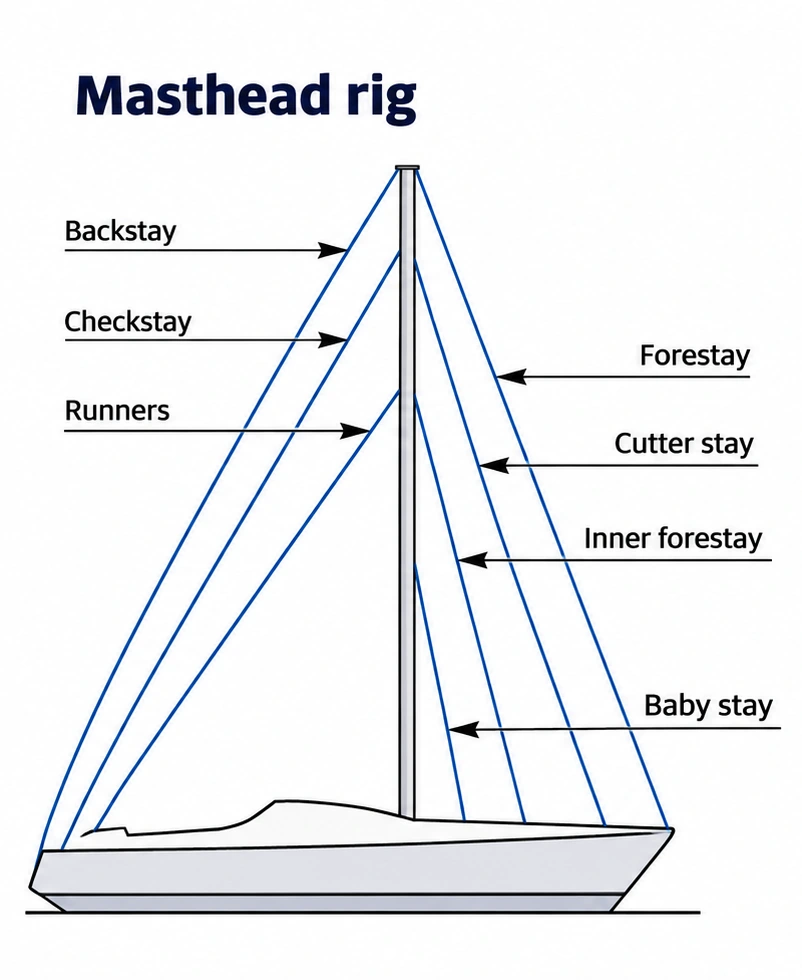
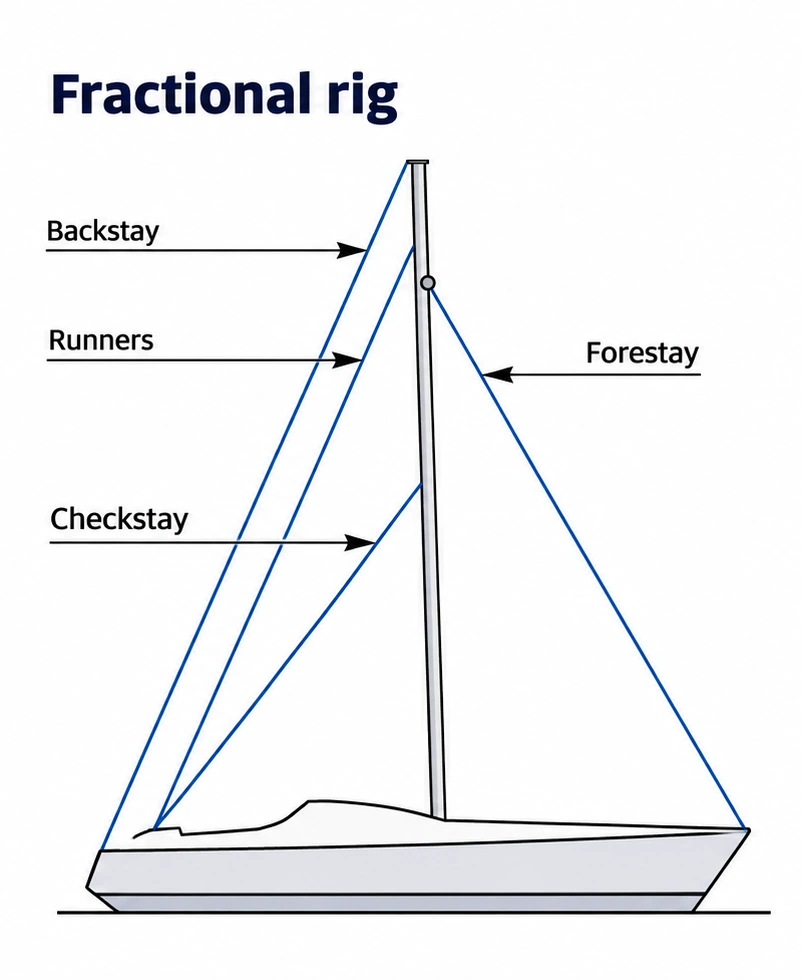
Bow to the right; stern to the left. These are schematic examples of possible stays, not a specification for any particular yacht. Runners and checkstays attach independently at different heights.
Forward stays
Forestay / headstay: the principal forward stay, usually attached near the masthead on a masthead rig, or below it on a fractional rig. A cutter stay or inner forestay may provide an additional headsail attachment. A baby stay, where fitted, supports or controls a lower mast panel.
Aft stays
Backstay: supports the mast aft and can be single or split. Runners are adjustable aft supports, often used with fractional rigs or inner forestays. Checkstays attach lower down and help control mast bend and pumping; they are not fitted on every yacht.
On a ketch, a triatic stay can connect the mainmast and mizzen mastheads. The rig's actual arrangement must be confirmed from its plan before measuring or specifying any replacement.
| Arrangement | Typical identifying features | Why it matters for replacement |
|---|---|---|
| Masthead rig | Forestay and principal aft support attach near masthead height. | Check full-height supports, the number of spreaders and any intermediate or lower shrouds. |
| Fractional rig | Forestay attaches below the masthead; cap shrouds, swept spreaders, backstay or runners vary with design. | Do not infer forestay or shroud lengths from an equivalent-length masthead rig. |
| Single-spreader rig | One spreader level, commonly with cap and lower shrouds. | Identify the separate lower attachments, including any forward and aft lowers. |
| Multiple-spreader rig | Two or more spreader levels, potentially with intermediate and diagonal rigging. | Use the specific mast plan to identify each segment, terminal and spreader-end connection. |
What do V1, V2, D1 and D2 mean?
Verticals (V) and diagonals (D) are commonly used in rigging schedules to distinguish the principal vertical load paths from diagonals attached at spreader levels. The number usually relates to the level or segment, but practice varies by rig designer and rigging system. A V1 may be the lower portion of a vertical or cap-shroud system; D1 is commonly used for a lower diagonal; higher-numbered designations identify upper levels on some multi-spreader rigs.
Do not order by label alone. A single continuous cap shroud, separate discontinuous segments and a swept-spreader rig may use different nomenclature and terminal arrangements. B&R rigs may also use dedicated reverse-diagonal labels such as RD1 or RD2. If the labels are not present on the yacht's drawing, record the actual attachment points and use photographs.
Reading a multiple-spreader rigging diagram
The example below shows how V- and D-labels may be used to identify separate components at different spreader levels. It illustrates one arrangement—not a universal schedule for every yacht.
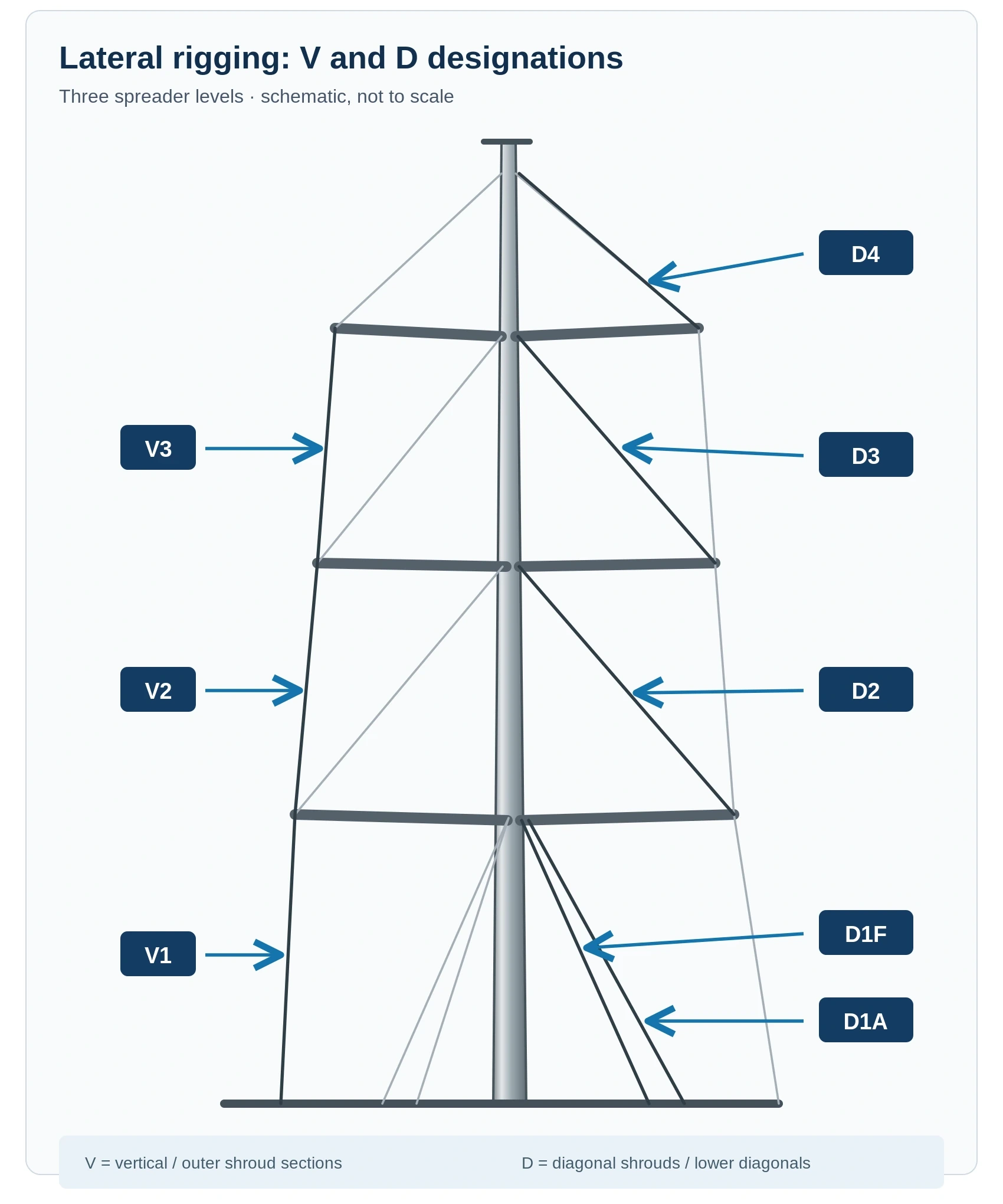
Schematic standing rigging layout. Exact stay routing, continuity and naming depend on the individual rig.
Jumper struts on some fractional rigs
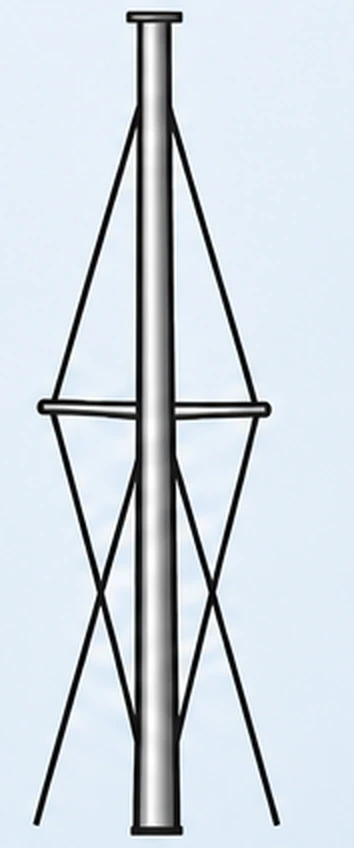
Example of a jumper arrangement (schematic).
Some fractional rigs have short jumper struts supporting a slender topmast. The jumper wires brace the upper section of the spar and can contribute fore-and-aft as well as lateral support, depending on the design.
A jumper is not fitted to every fractional rig. Refer to the mast manufacturer's arrangement for the actual attachment points.
How do common names relate to V and D?
Cap shrouds / outer shrouds: on this discontinuous three-spreader example, the near-vertical outer segments are V1 (deck to first spreader), V2 (first to second spreader) and V3 (second to third spreader).
Lower shrouds: where separate forward and aft lowers are fitted, these can be described as D1F (forward lower) and D1A (aft lower). They lead from the lower mast region to the deck.
Intermediate / diagonal shrouds: D2 braces the panel above the first spreader and D3 the next panel up. In this example D4 braces the top panel above the highest spreader.
Forestay, backstay and cutter / inner stays: these run fore-and-aft, rather than being V or D lateral shrouds. A backstay may comprise an upper span and separate lower legs.
Important: the same rig may use a continuous cap shroud passing through several spreader tips, rather than separate V1–V3 lengths. The numbering and terminology are not universal. Check the actual spar manufacturer's plan before specifying dimensions or fittings.
This technical illustration is deliberately schematic and cannot be used to calculate wire lengths, loads or terminal specifications.
Linked and continuous shrouds at the spreader
At a spreader tip, the rigging may be built from separate lengths joined by specialised links, or a continuous shroud may pass through a suitable spreader-end fitting. The replacement method and required terminations are different, so check which arrangement is fitted.
Linked / discontinuous
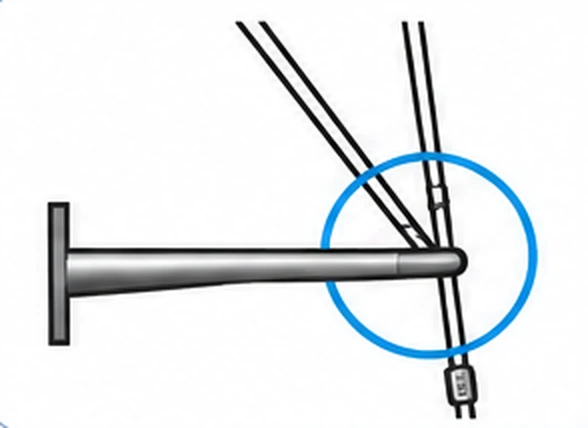
Separate rigging sections meet at a spreader junction. Identify each link, terminal and individual section before replacement.
Continuous
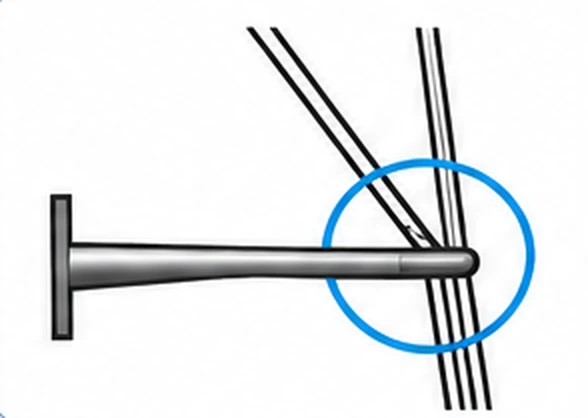
A shroud passes through the spreader end and continues to another point. Confirm the correct spreader-end interface and overall measurement datum.
Illustrations are simplified for identification. Real spreader terminals, alignment, link plates and load paths vary by mast manufacturer.
Common stay and shroud names
| Item | Typical role | V/D relationship and identification |
|---|---|---|
| Forestay / headstay | Forward mast support, often carrying a headsail furling system | Not a V/D shroud. Record furler interfaces, toggles and the load-bearing length. |
| Backstay / split backstay | Aft support; may divide into upper span and lower legs | Not a V/D shroud. List the upper span, junction and each lower leg separately. |
| Cap shroud | Major lateral support to upper mast via spreader tips | Often represented by V1, V2 and V3 on discontinuous multi-spreader rigs. Check whether the actual cap shroud is continuous. |
| Lower shrouds | Support lower mast section; may be forward and aft lowers | Often D1F (forward lower) and D1A (aft lower) in this type of schedule; record port and starboard separately. |
| Intermediate / diagonal shrouds | Support mast sections between spreaders or tangs | D2, D3 and sometimes D4 identify diagonal panels; V2/V3 identify the associated outer vertical sections. |
| Inner / cutter stay | Additional forward support for inner headsail or sail plan | Not a V/D shroud. Confirm removable fittings and any deck reinforcement. |
How to identify your yacht's rigging before requesting a quote
- Find the mast plan. Use the yacht or spar manufacturer's documentation wherever available.
- Make a photograph schedule. Capture each spreader level, mast tang, deck chainplate and both ends of each shroud.
- Separate port and starboard. Even where two shrouds appear symmetrical, verify rather than assume they are identical.
- Identify the fitting. Note wire type, diameter, stemball, T-terminal, fork, eye, stud, rigging screw and pin details.
- Confirm measurement datums. Never submit an unexplained overall length. Refer to our standing rigging measurement guide and the private measurement pack available on request.
What about ketches and other two-mast yachts?
Identify mainmast and mizzen rigging separately, including each mast's forestay, backstay, shrouds and any inter-mast stays. Mixed masthead and fractional arrangements, split backstays and non-standard modifications can make schedules more complex. A rigging list should always identify which mast each item belongs to.
Frequently asked questions
Are cap shrouds and V1 the same thing?
Not universally. “Cap shroud” describes a function, while V-designations describe positions or segments in a particular schedule. Check the actual mast plan before assuming an equivalence.
Can I identify wire lengths from the yacht's make and model?
A database or original plan can be a useful starting point, but mast variants, modifications and manufacturing differences mean final dimensions must be confirmed on the individual boat before manufacture.
What should I do if the shroud arrangement is unusual?
Photograph the mast and fittings and ask a qualified rigger to verify the rigging schedule. A component with an unidentified load path should not be replaced based on a generic diagram.
Explore Related Guides
Further practical advice from our rigging team to help you plan maintenance and replacement work.
Identify and Replace Your Yacht's Rigging
We can help confirm your rigging schedule before manufacturing replacement stays and shrouds.
Technical information is general guidance. Standing rigging is safety-critical; the yacht's actual design, condition and manufacturer specifications take precedence.